Freeze dance
Play a short instrumental track and invite everyone to move; pause the music and hold still until it starts again.
Materials: Music player and a clear floor

A room to play in, a few familiar things and a little imagination: start with a game that fits your child and the space you have.
Fifty ideas for active, quiet, learning and group play, with materials, age guidance and room notes for parents and teachers.
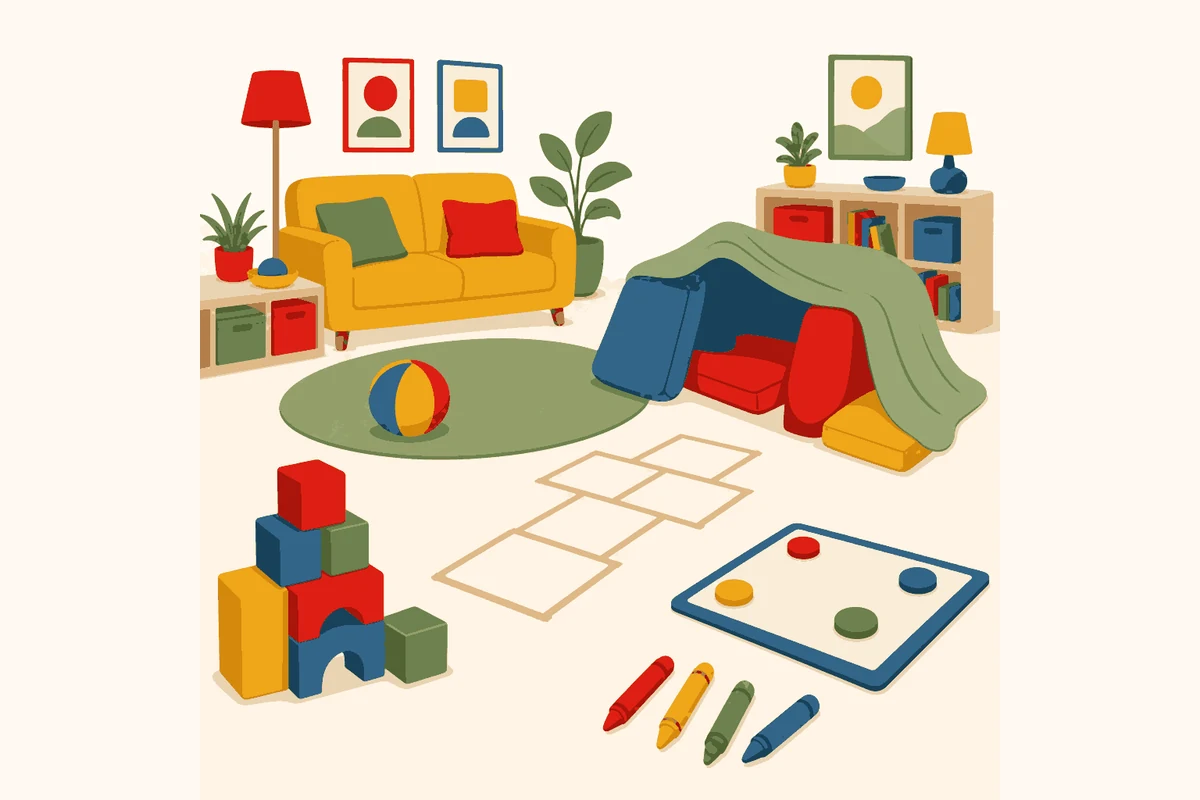
Choose a game by number to jump straight to its instructions. Ages are starting points, not fixed rules; adapt the pace and materials to the child.
These active indoor games for kids keep movement simple and contained. Clear the floor first and choose a pace that suits the room.
Play a short instrumental track and invite everyone to move; pause the music and hold still until it starts again.
Materials: Music player and a clear floor
Call out an animal and move like it from one marker to another, keeping each journey slow and controlled.
Materials: Floor markers, optional
Tap a balloon gently back and forth over a low cushion or line. An adult must supervise closely; remove burst pieces immediately.
Materials: One balloon and a low cushion or line
Make a short path of tape squares and step or hop from one square to the next without rushing.
Materials: Floor-safe masking tape
Arrange a few cushions as walk-around markers and invite children to step over or around them at walking pace.
Materials: Stable cushions
One caller gives gentle actions; players follow only when the instruction begins with “Simon says”. Keep every movement in place.
Materials: None
Walk around a circle of cushions while music plays. When it stops, sit on a cushion; nobody is out and everyone keeps a place.
Materials: Music player and one cushion per player
Roll clean socks into a soft ball and take gentle underarm throws into a laundry basket placed nearby.
Materials: Clean rolled socks and laundry basket
Keep one balloon floating with gentle taps while standing in one spot. Adult supervision is required; collect burst pieces straight away.
Materials: One balloon
Take turns choosing slow movements such as reaching, tiptoeing in place or stretching; the group copies without running.
Materials: None
Name an animal and try a simple, comfortable pose together, holding only as long as it feels easy.
Materials: Non-slip mat or clear floor
Players take a few walking steps on green and freeze on red. Keep the route short and do not run indoors.
Materials: Two coloured cards, optional
Quiet activities offer a different rhythm for a slower afternoon, shared focus or a little time at the table.
Choose a visible object and give a colour or shape clue. Take turns guessing what the other person has spotted.
Materials: Objects already in the room
Look at a small set of familiar objects, cover them, then recall or point to what was there. Start with just a few items.
Materials: Tray, cloth and large familiar objects
Choose an age-suitable puzzle and work together to find edge pieces, colours or matching details.
Materials: Age-suitable puzzle with large pieces
Invite a child to build anything they imagine, or offer a simple prompt such as a bridge for a toy.
Materials: Large blocks, especially for under-3s
Roll and press non-toxic dough into shapes, then describe each creation together. Supervise young children closely.
Materials: Non-toxic playdough and large blunt tools
Thread a thick lace through large holes in a sturdy card, following its edge or making a pattern.
Materials: Large-hole lacing card and thick lace
Sort large toys or cards into colour groups, then choose a new rule such as light and dark.
Materials: Large coloured objects or picture cards
Use large stickers to make a scene on paper, then talk about what is happening in the picture.
Materials: Large stickers and paper
Shine a torch towards a clear wall and make hand shadows. Keep the torch pointed away from eyes.
Materials: Torch and clear wall
Choose a picture from a book or large picture cards and take turns adding one sentence to a story.
Materials: Picture book or large picture cards
Playful ways to notice letters, sounds, patterns and ideas together. Keep materials age-appropriate and make room for more than one answer.
For body-part naming, see body parts in English for preschoolers. Try the fruit and vegetable naming guide, or explore teaching-aid style learning games.
Choose one letter and find it on book covers, labels or large letter cards around the room.
Materials: Books or large letter cards
Label a few floor-safe tape squares with numbers; step between them and say each number aloud.
Materials: Floor-safe tape and number cards
Pick a shape and spot matching objects nearby, naming each one as you find it.
Materials: None
Show three large pictures or objects, two with something in common, and ask which one is different and why.
Materials: Large picture cards or objects
Say a familiar word and think of another word that rhymes; make up playful nonsense rhymes too.
Materials: None
Count sealed, commercially made beanbags into a basket, one at a time. Do not use loose beans or homemade bags that can open.
Materials: Sealed beanbags and basket
Spread large letter cards on the floor and use a toy fishing rod or point to “catch” a named letter.
Materials: Large letter cards and toy rod, optional
Listen to two safe, everyday sounds and decide whether they match; use visible objects so children need not close their eyes.
Materials: Familiar sound-making objects
Mix small amounts of washable paint in two primary colours and notice the new colour together.
Materials: Washable paint, paper, smock and adult supervision
Give simple prompts such as “touch your shoulders” or “wiggle your fingers”; children can choose a comfortable movement.
Materials: None
A voice, a partner or an idea can be enough. These no-equipment games travel easily from a rainy-day pause to a family gathering.
Call out a pose and invite everyone to hold it briefly, then relax and choose a new pose.
Materials: None
Whisper a short, familiar phrase to the next person and compare the final version with the original.
Materials: Two or more players
Make a gentle sound with your voice, such as a hum or animal call, and let others guess what it could be.
Materials: None
Face a partner and copy slow, comfortable hand or face movements; swap who leads after a short turn.
Materials: None
Show a number with fingers and invite a partner to copy it; keep it playful rather than timed or competitive.
Materials: None
Make a short clap-and-pause pattern for others to repeat, then let a child invent the next pattern.
Materials: None
Take turns making a gentle expression such as happy, surprised or puzzled and guess the feeling together.
Materials: None
Start a story with one sentence and take turns adding one sentence each until the group reaches an ending.
Materials: Two or more players
For birthday parties and playdates, cooperative rounds can make room for everyone. Explain the rules first and keep movement at walking pace indoors.
Pass a soft parcel while music plays; pause for the holder to unwrap one layer and do a simple action before play continues.
Materials: Soft parcel with several paper layers and music
Hide a few large picture clues in easy-to-reach places and work together to find them in order.
Materials: Large picture clues and a small treasure
Move gently in place while music plays and freeze when it stops; everyone stays in the game each round.
Materials: Music player
Sit in a wide circle; a caller walks around and gently taps shoulders before choosing the next caller. No chasing or running indoors.
Materials: None
Act out a familiar animal, object or action without speaking while the group guesses; let every child pass or choose a clue.
Materials: Picture prompt cards, optional
In pairs, carry a balloon between two hands while walking to a marker and back. Adults supervise; stop if a balloon bursts and collect every piece.
Materials: Balloon, marker and adult supervision
Walk a short route carrying a soft ball on a large spoon, then hand it to the next player; no running or blindfolds.
Materials: Large spoon, soft ball and marker
Pass a soft ball around a seated circle while music plays. When it stops, the holder names an animal or chooses the next action.
Materials: Soft ball and music player
Work in a small team to build a tower from large blocks, taking turns to add one piece at a time.
Materials: Large, lightweight blocks
Give each player a picture board and call out matching images; use large cards and let players point rather than use small counters.
Materials: Picture bingo boards and large markers or fingers
Children develop at different rates, so use age as a flexible guide and adapt the rules, materials and length of play.
Choose short, simple turns with familiar objects and an adult close by.
Offer clear rules, a little choice and plenty of time to practise.
Children can often follow two-step directions and enjoy simple challenges.
Try longer turns, early team plans and games with several clues or rules.
A quick room check and age-suitable materials help make everyday play more comfortable.
Move hard or breakable objects, check the route and give children enough room to move safely.
Use soft, lightweight balls indoors and keep throws gentle and away from faces and fragile objects.
Use large, non-choking pieces for children under 3 and supervise them closely throughout play.
Balloons are only for children aged 4 and up with close adult supervision. Burst balloon pieces are a choking risk; collect them immediately and keep uninflated balloons away from young children.
Use a dry, non-slip surface and stable cushions; remove tape or objects that could slide underfoot.
Offer breaks when children need them and stop an activity if someone is tired or uncomfortable.
Use household objects, movement, conversation and imagination instead of relying on a screen to lead the game.
Print a simple A4 checklist of all 50 game names and tick off the ideas your family would like to try.
Your browser’s print dialogue will open. Select A4 paper and print or save as PDF.
Practical answers for choosing indoor games for children at home.
Try a familiar game with simple instructions, such as I spy, freeze dance, block building or a picture puzzle. Choose a version that suits the child’s age and available space.
Many three-year-olds enjoy animal walks, statues, colour sorting, mirror me and simple picture hunts with an adult nearby. Use large pieces and short turns.
Statues, whisper chain, mirror me, emotion faces, clapping patterns and story chain can be played without special equipment.
Offer a choice of active, quiet and make-believe games, clear a safe area and change activities when interest shifts. Allow time for water, snacks and rest.
Picture bingo, team tower building, pass the parcel and a picture-clue treasure hunt can suit a group. Explain the rules and adapt the game to the room and ages.
Play gives children opportunities to practise movement, language, turn-taking, problem-solving and imagination. What they practise depends on the game and the child.
There is no single duration for every child. Follow their cues, offer water and rest, and stop when a child is tired or uncomfortable.
Picture puzzles, memory tray, block building, sticker scenes, story pictures and colour sorting offer a calmer pace.
Related reading: play-based learning in early childhood, 50 fun learning activities for preschoolers and yoga and mindfulness for preschoolers.
For monsoon days, try these rainy season activities for kindergarten.
Find programme information and more practical ideas for play and early learning.
Browse programme information and related activity guides.
A simple checklist for family play. Tick each idea you would like to try.