Head सिर
It holds the face and sits above the neck.

A simple list of body parts names in English with Hindi meanings, a labelled picture, playful learning ideas and a free worksheet for nursery and KG children.
Begin with familiar words, then explore face parts, body parts inside us and the five senses at a child's own pace.
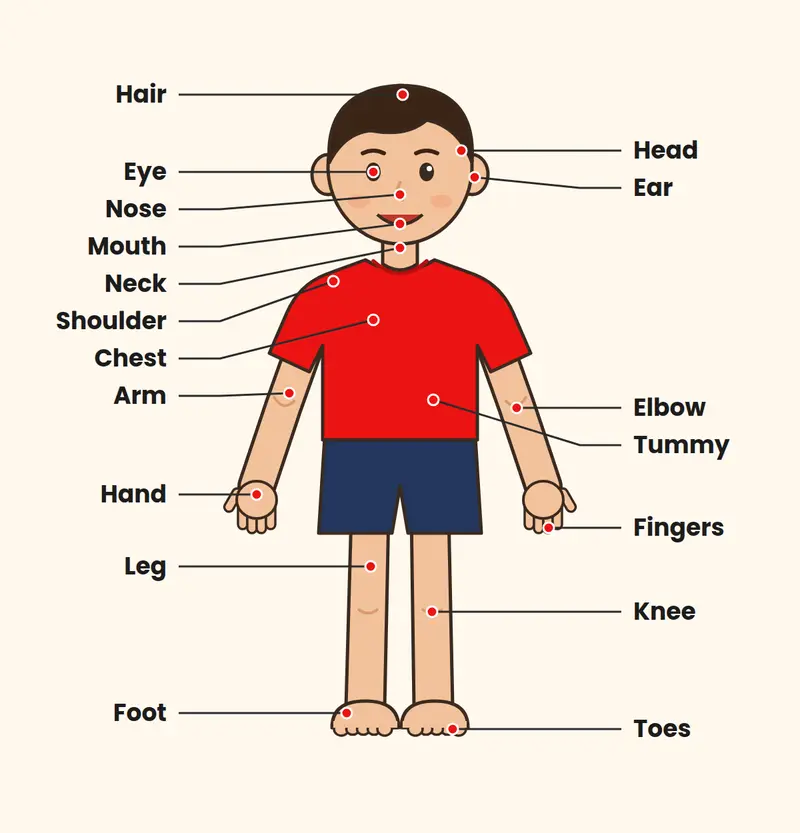
Labelled picture: 18 body parts names in English.
View or save the labelled diagram imageBrowse 50 body parts names in English and Hindi, with Hindi written in Devanagari and Roman letters. Each row copies all three forms together. Hindi names can vary by region and family; these are familiar everyday words.
| English | हिन्दी | Roman Hindi | Copy a wordCopy |
|---|---|---|---|
| Waist | कमर | kamar | Waist | कमर | kamar |
| Head | सिर | sir | Head | सिर | sir |
| Hair | बाल | baal | Hair | बाल | baal |
| Forehead | माथा | maatha | Forehead | माथा | maatha |
| Eyebrow | भौंह | bhaunh | Eyebrow | भौंह | bhaunh |
| Eye | आँख | aankh | Eye | आँख | aankh |
| Eyelash | बरौनी | barouni | Eyelash | बरौनी | barouni |
| Ear | कान | kaan | Ear | कान | kaan |
| Nose | नाक | naak | Nose | नाक | naak |
| Cheek | गाल | gaal | Cheek | गाल | gaal |
| Lips | होंठ | honth | Lips | होंठ | honth |
| Mouth | मुँह | munh | Mouth | मुँह | munh |
| Teeth | दाँत | daant | Teeth | दाँत | daant |
| Tongue | जीभ | jeebh | Tongue | जीभ | jeebh |
| Chin | ठोड़ी | thodi | Chin | ठोड़ी | thodi |
| Neck | गर्दन | gardan | Neck | गर्दन | gardan |
| Shoulder | कंधा | kandha | Shoulder | कंधा | kandha |
| Chest | छाती | chhaati | Chest | छाती | chhaati |
| Arm | बाँह | baanh | Arm | बाँह | baanh |
| Elbow | कोहनी | kohni | Elbow | कोहनी | kohni |
| Wrist | कलाई | kalaai | Wrist | कलाई | kalaai |
| Hand | हाथ | haath | Hand | हाथ | haath |
| Palm | हथेली | hatheli | Palm | हथेली | hatheli |
| Fingers | उँगलियाँ | ungliyan | Fingers | उँगलियाँ | ungliyan |
| Thumb | अंगूठा | angutha | Thumb | अंगूठा | angutha |
| Nail | नाखून | naakhoon | Nail | नाखून | naakhoon |
| English | हिन्दी | Roman Hindi | Copy |
|---|---|---|---|
| Knuckle | उँगली का जोड़ | ungli ka jod | Knuckle | उँगली का जोड़ | ungli ka jod |
| Tummy | पेट | pet | Tummy | पेट | pet |
| Back | पीठ | peeth | Back | पीठ | peeth |
| Hip | कूल्हा | koolha | Hip | कूल्हा | koolha |
| Thigh | जाँघ | jaangh | Thigh | जाँघ | jaangh |
| Leg | टाँग | taang | Leg | टाँग | taang |
| Knee | घुटना | ghutna | Knee | घुटना | ghutna |
| Shin | पिंडली का सामने वाला भाग | pindli ka saamne wala bhaag | Shin | पिंडली का सामने वाला भाग | pindli ka saamne wala bhaag |
| Calf | पिंडली | pindli | Calf | पिंडली | pindli |
| Ankle | टखना | takhna | Ankle | टखना | takhna |
| Foot | पैर | pair | Foot | पैर | pair |
| Heel | एड़ी | edi | Heel | एड़ी | edi |
| Toes | पैर की उँगलियाँ | pair ki ungliyan | Toes | पैर की उँगलियाँ | pair ki ungliyan |
| Toenail | पैर का नाखून | pair ka naakhoon | Toenail | पैर का नाखून | pair ka naakhoon |
| Brain | दिमाग | dimaag | Brain | दिमाग | dimaag |
| Heart | दिल | dil | Heart | दिल | dil |
| Lungs | फेफड़े | phephde | Lungs | फेफड़े | phephde |
| Stomach | आमाशय | aamaashay | Stomach | आमाशय | aamaashay |
| Intestines | आँतें | aanten | Intestines | आँतें | aanten |
| Liver | जिगर | jigar | Liver | जिगर | jigar |
| Kidneys | गुर्दे | gurde | Kidneys | गुर्दे | gurde |
| Bones | हड्डियाँ | haddiyan | Bones | हड्डियाँ | haddiyan |
| Muscles | मांसपेशियाँ | maanspeshiyan | Muscles | मांसपेशियाँ | maanspeshiyan |
| Skin | त्वचा | tvacha | Skin | त्वचा | tvacha |
Begin with the parts children can see and name in everyday life. Invite a child to point to a picture or to themselves; touching another person is never needed.
It holds the face and sits above the neck.
Hair grows on the head and can be combed.
Eyes help us notice colours, shapes and people.
Ears help us hear sounds around us.
The nose helps us smell and breathe.
We use the mouth to speak and eat.
The neck joins the head to the body.
Shoulders connect the arms to the body.
The chest is the front part of the upper body.
Arms help us reach and carry light things.
The elbow lets an arm bend.
Hands help us hold, wave and draw.
Fingers help us pick up and point to things.
Tummy is the everyday name for the outside belly area; the stomach is inside the body.
The back is the part behind the chest and tummy.
The hips are at the sides of the lower body.
Legs help us stand, walk and climb steps.
The knee is the joint in the middle of the leg.
The ankle joins the foot to the leg.
Feet support us when we stand and move.
The heel is the back part of the foot.
Toes are the small parts at the front of each foot.
Use a mirror, a drawing or a picture to notice these 12 face parts. Children can point to the matching part on their own reflection.
The forehead is above the eyebrows.
Eyebrows sit above the eyes.
Eyelashes grow along the edges of the eyelids.
Eyes help us see.
Ears help us hear.
The nose helps us notice smells.
Cheeks are on either side of the nose.
Lips form the outside edge of the mouth.
The mouth helps us talk, taste and eat.
Teeth help us bite and chew food.
The tongue helps us taste and form words.
The chin is the lower part of the face.
A few smaller names help children describe what they are drawing, dressing or using. Name a part without asking anyone to touch another person's body.
The palm is the inside surface of the hand.
Fingers bend and help us hold objects.
The thumb helps the hand grip and pinch.
Nails grow at the ends of fingers.
The wrist joins the hand to the arm.
A knuckle is a joint where a finger bends.
The thigh is the upper part of the leg.
The knee bends as we sit or step.
The shin is the front of the lower leg.
The calf is the back part of the lower leg.
The ankle is the joint above the foot.
The heel is at the back of the foot.
Toes are at the front of the foot.
A toenail grows at the end of a toe.
Internal body parts are inside us and are not seen from the outside. These simple descriptions introduce their roles without going into medical detail.
The brain helps us think, remember and move.
The heart pumps blood around the body.
The lungs help us breathe.
The stomach is one part of the digestive system.
The intestines are part of the digestive system.
The liver is an organ inside the body.
The kidneys are two organs inside the body.
Bones support the body; muscles help it move.
Connect each sense with a simple observation. Children can choose whether to take part, and activities never require tasting or touching unfamiliar things.
Look for two round shapes in a picture and name their colours.
Pause and notice a familiar sound nearby.
Name a familiar smell from a safe, everyday item.
Talk about a familiar food's flavour; never pressure a child to taste.
Compare the feel of two familiar objects, with permission.
Use these age bands as a guide, not a checklist. Children develop at different paces; repeat familiar words and add new ones when a child shows interest. Ages for the linked Rainbow programmes are measured as of 1 June.
Try: head, eyes, nose, mouth, hands, tummy and feet. Activity: name one part while looking together in a mirror or picture. See the Playgroup programme.
Try: face parts, arms, fingers, legs and knees. Activity: match a word to a part on a drawing. Explore the Nursery programme.
Try: wrist, palm, ankle, heel and the five senses. Activity: sort picture cards by face, hand, leg or sense. Learn about the Kindergarten programme.
Try: selected internal parts and their simple roles. Activity: label a large body outline together. Find details about the Kindergarten programme.
Age labels are a guide: the ranges above are approximate, and children's interests and readiness differ.
Keep rounds short, demonstrate first and let children watch instead of joining. Choose picture-based versions when movement is not comfortable.
Give a simple prompt such as “Simon says point to your elbow”. Children can point to themselves, a drawing or a doll.
Take turns making a face or pointing to a feature in a mirror. The child can lead or simply observe.
Invite children to touch their own nose, knee or toes and say its name. Never touch another person without permission.
Trace around a paper figure or draw a simple outline, then add labels together. Keep the activity on paper.
Use picture squares; call a word and let children mark or point to its picture.
Use a paper doll or toy to place simple clothing and name the body part each item covers.
Choose a familiar action song such as “Head, Shoulders, Knees and Toes”. Point to or move gently with each named body part; participation is optional.
Draw a face or body outline with one feature left off. Ask children to spot and draw the missing part.
Make participation optional and keep the language matter-of-fact. A child can point to a picture instead of their own body, and everyone should ask permission before touching another person.
Open a print-ready set of three A4 activity sheets. The first has an unlabelled figure and empty label boxes; the next two practise English–Hindi matching and the five senses.
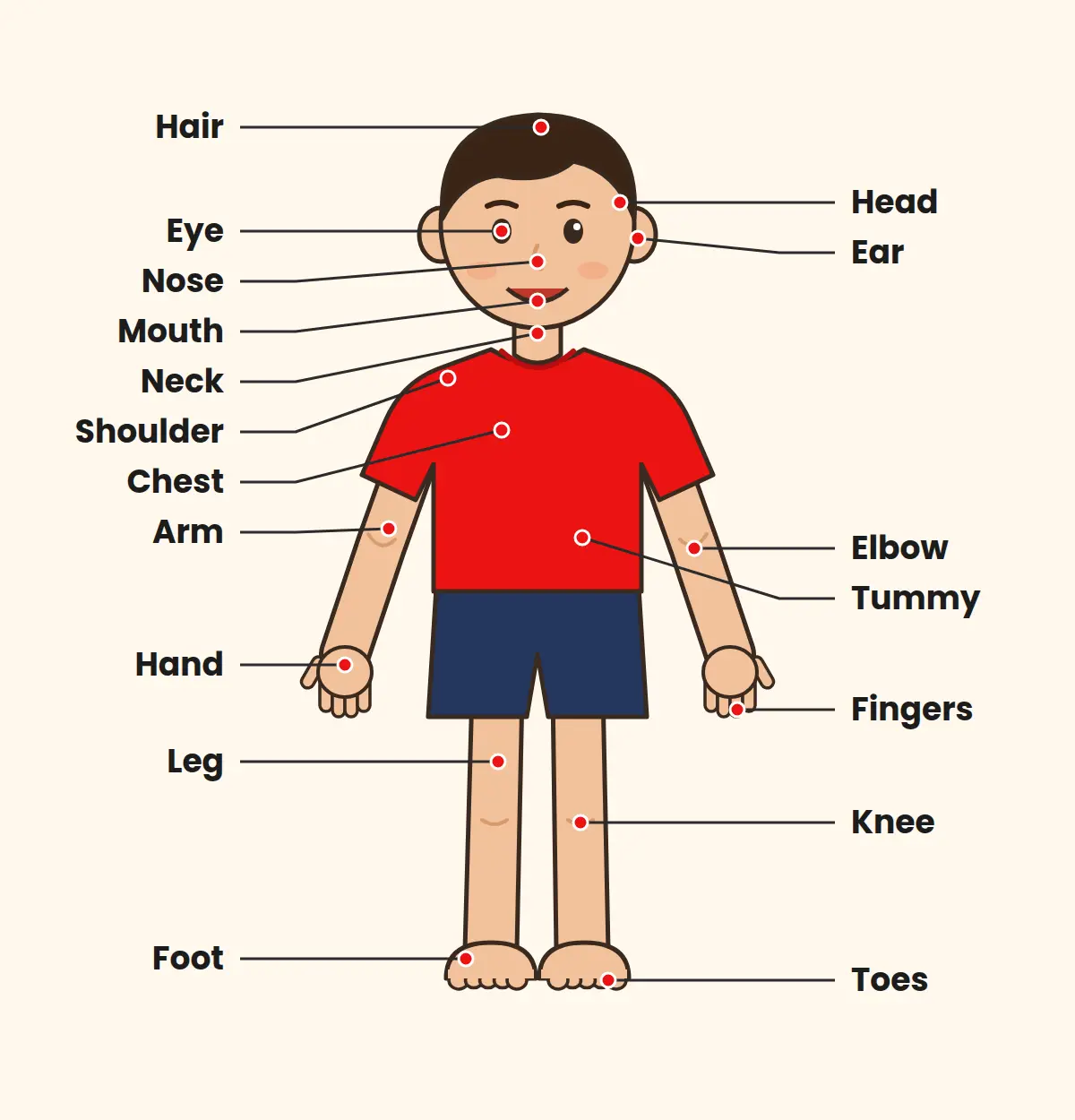 Save the labelled body diagram (WebP)
Sheet 1: label the body with empty answer boxes. Sheet 2: match English names to a scrambled Hindi list. Sheet 3: circle five sense organs among other body-part words.
Printing opens your browser's print dialogue. Choose A4 paper and print at actual size.
Short answers for adults introducing body vocabulary at home or in an early-years setting.
More family resources and programme information from Rainbow Preschool International.